

The Toast Principle: Why Recycled Content Works
A reluctant creator’s guide on how to think about re-purposed posts

We all know there are two types of people who share things online:
Content Creators with capital Cs who will be shamelessly consistent in doing whatever it takes to keep their engagement high and the ‘rest’ of us believing we can too if we follow.
Artsy souls letting the wind and their spirit carry their thoughts onto the page, making whatever their mind conjures up, while secretly hoping that they too will see ‘success’.
Those who believe in the Rule of Three and think a two-entry list is no list at all, no matter how the idea was originally introduced. We’ll just ignore them [which, I guess, includes me and my dry humour].
We also know that creating new works of any type or genre is time-consuming. This holds true no matter how meticulously streamlined one’s publishing workflow may be. Actioning every thought takes time.
The clever creative knows a ‘hack’ to this truth, and it comes in the form of ‘recycled’ content—the act of copying, savings, finding, pasting, and re-delivering something that has been seen by others before. It still takes time, but when the aim is driving exponential engagement, it can seen as a more economical approach.
I resisted recycling content for so long, and often still do. However, I’ll admit to the experimentation I’ve done on other platforms to put this practice to the test. In reviewing the results, I finally understood the rationale.
I am not going to argue for or against this approach. But, if we put aside the icky feeling of re-purposing and publishing what were once-original thoughts for a moment, I can now better explain why this works.
And with alliterative analogy as my favourite avenue for analysing content creation approaches, we shall sharpen our strategic skill sets by starting in the kitchen… where we will promptly drop this alliteration attempt as abruptly as it came. It was fun when I wrote that, but even I got grossed out.
So, let’s just talk about toast. 🍞 Mmm. Much better.
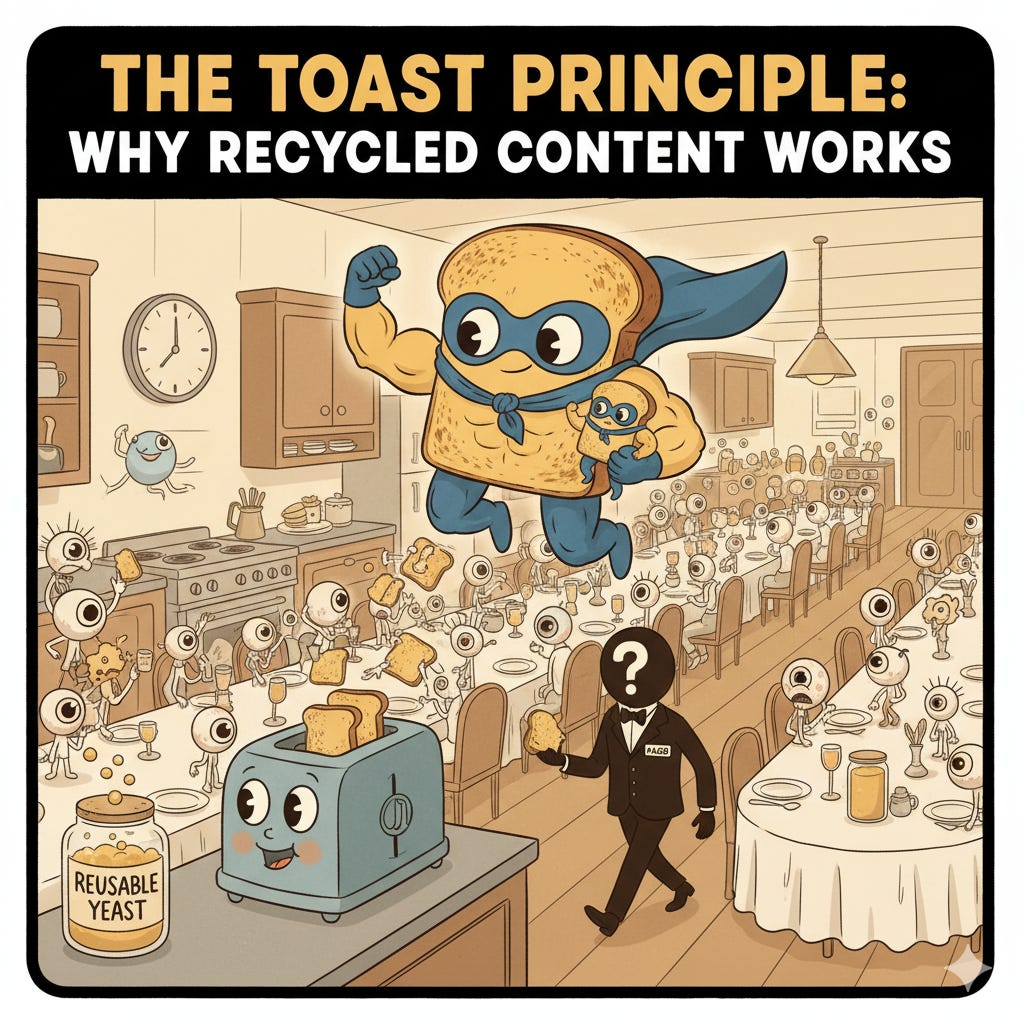
When we’re creating things for consumption by online eyeballs and ears, I was told to think of your posts as toast and your social profile as the toaster. Publishing pops up your posts, ready to be enjoyed and eaten. Yet every toast post needs distribution.
Picture, now, a banquet hall of hungry guests, yet not one of them your Follower. They came here to be fed, but not necessarily by your kitchen. So, you’ve put your trust in Algo the silent waiter to take your toast around to every table.
Some partake and some don’t. Some even Subscribe for seconds. The dining hall remains hungry regardless, and many more enter each day.
A baker’s delight. Millions of minds eager for a feast.
Every recipe requires raw ingredients, and those take time to source. The clever cook, however, knows a tactical hack to keep the toast coming in the form of reusable yeast. The last batch had gone over well, and could be trusted to rise well again.
A familiar smell emits from their toaster; one that you might have sniffed last week.
But the baker is not bothered by those he has served before. You see, he’s got his sights set on the new patrons shuffling through the door. He can recut and re-release yesterday’s toast, and more.
We all know how to be the baker. The question is whether we can stomach it.
Chef Substack does not care if you post the same toast Note once a week, so long as new people are biting.
So, if you’re still considering going down this content path of replicated writing as a means of staying present, here’s the gist of The Toast Principle for social media without all of my meandering metaphors:
You’re not the only creator making new content and your faithful Followers have lives of their own too
This means that 50% of what you share will probably never be seen by those who know you; this isn’t Facebook in 2006 or Instagram in 2011 where your friends come to your profile every day to see the latest experience you’ve shared
Each time you post a Note here or a video on some other platform, it’s the algorithm that acts as the arbiter in deciding how many new people get to see it
The more toast you post, you’re serving up more chances for the algorithm to share it around to see how many other people might like it
When you’re playing the volume-for-eyeballs game (ie. relentlessly posting something ‘new’), recycling something you had written or filmed a month ago doubles your chances of that particular piece getting seen
At worst, your subscribers had already seen it and now feel you’re being cheap
At best, they’re seeing the thing you shared this second time around when they hadn’t before because they were busy making their own way through this mess.
Huzzah for gaming the system! To each their own. Choose your pain.
Love this... This is a good metaphor, and it helps change perspectives. I love my picture in the middle of it, of course. THank you!
“The last batch had gone over well, and could be trusted to rise well again.” Gotta find a batch that works first! Bew to Substack, still waiting for the first note to get some real traction.